
• Company profile design
Your business's handshake, on paper.
A company profile is the document that speaks for you when you are not in the room. Ours are built to do one job: make a serious buyer decide you are established, careful and worth a meeting — before a single word is spoken.
• Why it matters
Trust is the currency.
A profile is how you spend it.
A profile is the one asset that answers "who are these people?" completely, in a form a prospect can forward to the people who were not at the meeting.
Credibility before the conversation
A well-made profile proves you are an established expert before anyone speaks. It settles the question of legitimacy quietly, so the meeting can be about the work instead.
Big-brand weight on day one
New managed firms lose contracts to bigger names on perception alone. A proper profile closes that gap immediately and helps you win the early clients that make everything after it easier.
One story as you grow
Established firms accumulate services faster than they can explain them. A profile consolidates the lot into one coherent account for stakeholders, partners and new hires on their first day.
• Why it matters
Prove it before you touch
a client's server.
Anyone can claim they are responsive and secure. A profile is where you show it — with numbers a prospect can check, standards a procurement team recognises, and stories from businesses like theirs.
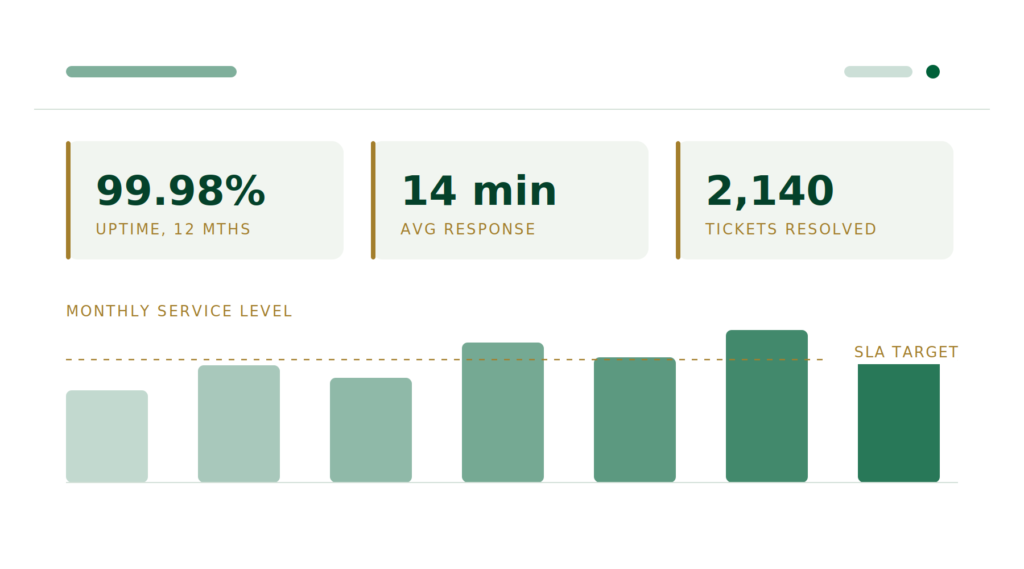
Show the numbers
Uptime statistics and response benchmarks turn "reliable" into something measurable. We design these as the visual anchor of the page, not a footnote in a paragraph.
Certifications and compliance
ISO 27001, SOC 2 or Privacy Act marks tell a procurement team you meet rigorous external requirements. We lay them out cleanly and note what each one actually covers.
Tell the proactive story
Explaining your monitoring process is what separates you from a break-fix shop. We diagram it so a reader understands you prevent outages rather than merely repair them.
Short, specific case studies
Two paragraphs on how you kept a business stable through a migration or an incident builds more trust than a page of adjectives. Situation, action, measurable outcome.
• Why it matters
The best outage is the one nobody noticed.
That is a hard thing to sell, because the evidence is an absence. We design the proof around it: the alert that fired at 2am, the capacity added before anyone logged in, the ticket closed before the office opened.
The same treatment works for your service-level data. Instead of a table nobody reads, the numbers become the thing a reader remembers — and the thing they quote to a colleague when they are making the case for you internally.
• What goes inside
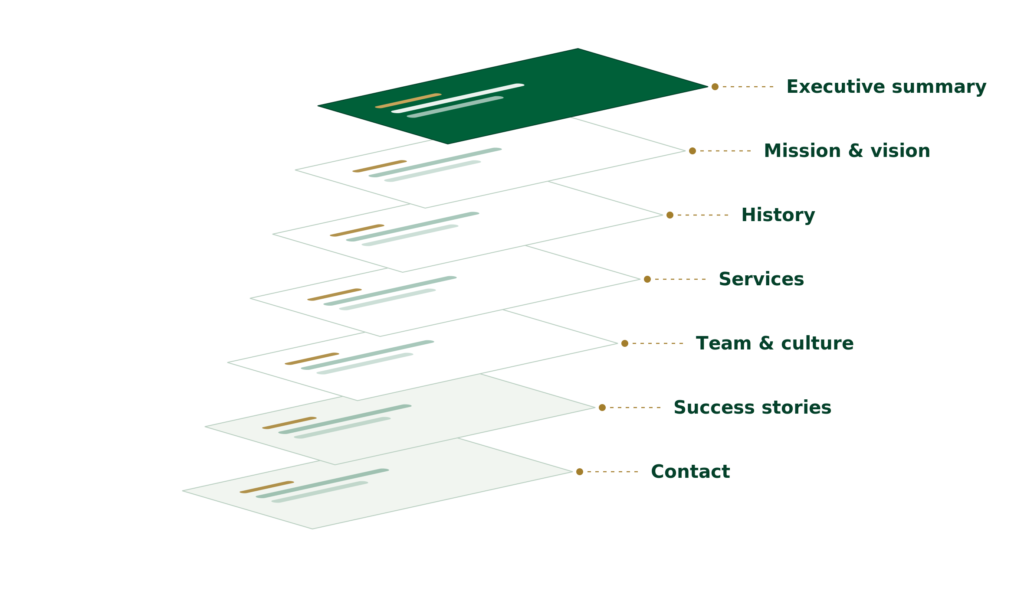
Seven sections, in the order
a reader needs them.
This is the standard structure for a client company profile. We adapt the order and weighting to the business, but every profile answers these questions — and answers them in a sequence that builds rather than repeats.
Executive summary
The whole business in one page, written so a reader who stops here still knows what you do and who you do it for.
Company history
How it started and what the journey has been. Longevity reads as stability, and stability is what a nervous buyer is looking for.
Team & culture
Leadership, expertise and values. People buy from people, and this is where an abstract company becomes a set of faces.
Contact & next step
One clear action, with a named person where possible. A profile that ends without an obvious next move wastes everything before it.
Mission & vision
Core purpose and where the company is heading — stated plainly, without the language everyone else uses.
Products & services
What is on offer, framed by the benefit rather than the feature, and structured so a buyer can find their own situation quickly.
Success stories
Case studies and testimonials placed where doubt usually sets in — right after the claims, as evidence for them.
Your raw details, transformed
You supply the facts in whatever state they are in. We turn them into a document that looks like it came from a company three times the size.
Move beyond the basics with a profile that closes the deal.
• Startup or established
The same seven sections,
weighted very differently.
A three-year-old company and a thirty-year-old one are not selling the same thing. One is selling potential, the other proof. We restructure the profile around whichever you actually have.
Startups
Potential
Founding story, not history
There is no decades-long past to draw on, so we build around the moment the founders saw the problem — and why they cannot leave it alone.
Problem & solution
Dedicated space for the pain point being addressed. At an early stage this is what makes the business credible, more than any credential.
Traction, not case studies
Pilot programmes, beta feedback, waitlist numbers, letters of intent. Early validation counts as evidence when framed honestly.
Roadmap
What is coming next — features, hires, expansion. Investors and early clients are buying the direction as much as the current product.
The team
Why these specific founders are the right people to win this market. Expertise and unfair advantages, stated without modesty.
Established Firms
Proven
Milestones & legacy
Longevity and key achievements laid out as a timeline. Years in business is the single most persuasive stability signal you own.
Evolution of expertise
How the company adapted through each industry shift. This is what makes a long history read as experienced rather than outdated.
Proven results
Deep case studies and long-term client testimonials. Retention figures do more work here than any new-business claim.
Scalability & infrastructure
Established teams, documented processes, redundancy. The things a younger competitor cannot claim yet.
Vision for the future
Proof that the company is still innovating. Without it, a long history starts to read as a company coasting.
• Our process
Three stages, and you will never
be asked to review a guess.
Most of the work happens before anything is designed. By the time you see a layout, the argument it makes has already been agreed in writing.
01 - Discovery
Learn the mission
Interviews with the people who know the business, an audit of what already exists, and agreement on the audience and the single decision this profile needs to move. You approve a written direction first.
02 - Visual storytelling
Map the services
We turn the raw material into structure: what earns a full spread, what becomes a diagram, what gets cut. Then layout, original charts and edited copy, with two rounds of revisions included.
03 - Polished delivery
Hand over the finished thing
Press-ready artwork, a tagged and bookmarked PDF for email, and locked master templates so your team can update figures next quarter without redesigning the document.
• Start here
Move beyond the basics with a profile that closes the deal.
Tell us who the profile is for and what you need it to prove. We will come back with a structure, a timeline and a fixed price — whether it is your own profile or one you are producing for a client.